
Authored by Samira Ranjbarrad – 11/10/2026
Modern engineering teams need more than a CFD solver. Simcenter STAR-CCM+ connects CAD preparation, automated meshing, high-fidelity multiphysics, workflow automation, data analysis and design exploration in one environment. With Design Manager and Simcenter PhysicsAI, teams can extend trusted CFD models into broader design-space studies and rapid AI-assisted prediction, while keeping physics-based simulation at the center of validation and decision-making [1, 2].
The Challenge
High-fidelity CFD provides detailed engineering insight, but a one-design-at-a-time workflow can become a bottleneck as products and operating conditions evolve. Each new concept may require another cycle of geometry preparation, meshing, solving and review, while the number of possible design combinations quickly exceeds the number of simulations a team can realistically run.
The engineering challenge is therefore to explore more possibilities without losing confidence in the physics. Teams need repeatable workflows, efficient design-space exploration and practical ways to reuse the simulation data they have already generated. They also need fast access to modeling guidance so expert knowledge can be applied consistently across projects and users.
The STAR-CCM+ Approach
Simcenter STAR-CCM+ treats the simulation process as a connected workflow. Built-in CAD preparation, automated surface and volume meshing, integrated multiphysics, native automation, advanced post-processing and scalable CPU/GPU/ARM execution help engineers move from geometry to engineering insight without rebuilding the process around separate tools [1].
Design Manager extends the same model into systematic design exploration. Engineers can vary geometry and operating parameters, define objectives and constraints, and run sweeps, design-of-experiments and optimization studies. Recent STAR-CCM+ releases also improve turnaround by reusing nearby completed solutions to initialize new designs automatically [3].
Simcenter PhysicsAI adds a second acceleration layer. Integrated with STAR-CCM+ Design Manager, geometric deep-learning models can be trained from high-fidelity CFD data and used to predict full-field behavior for new geometries rapidly. STAR-CCM+ 2606 adds multi-GPU training, which Siemens reports can reduce PhysicsAI training time by up to three times [2, 4, 5]. Through the broader Simcenter X environment, integrated AI Chat provides natural-language access to Siemens documentation and knowledge-base content, helping users find modeling guidance and explore simulation options faster [6].

A connected workflow turns one high-fidelity CFD model into a reusable platform for simulation, design exploration and AI-accelerated prediction.
Use Cases
A parameterized STAR-CCM+ model can serve as the starting point for more than a single analysis. Once geometry, physics, reports and automation are established, Design Manager can explore how multiple parameters affect performance while preserving a consistent simulation workflow. This is useful for applications where engineers must balance competing objectives rather than optimize one metric in isolation.
For larger design spaces, PhysicsAI can learn from representative CFD results and predict new designs much faster than repeating every high-fidelity solve. Engineers can use those predictions to screen a wider range of concepts, identify promising regions of the design space and then return the strongest candidates to STAR-CCM+ for detailed CFD validation. The approach uses AI to expand exploration, not to replace the physics-based reference model [2, 5].
AI-assisted knowledge access supports the same workflow from another direction. Within Simcenter X, AI Chat can help users locate documentation, best-practice guidance and modeling options more quickly, reducing time spent searching for information while leaving model selection, assumptions and validation in the hands of the engineering team [6].
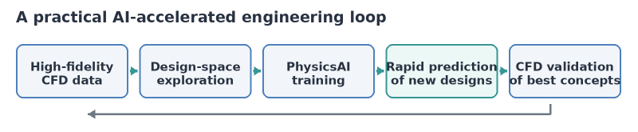
Use high-fidelity CFD to establish trusted physics, then combine design exploration and PhysicsAI to evaluate more concepts within the same development window.
Key Takeaway
Simcenter STAR-CCM+ connects high-fidelity multiphysics CFD with automation, embedded design exploration and AI-accelerated prediction. Design Manager turns a validated model into a systematic design study, PhysicsAI transforms accumulated CFD data into rapid predictions for new concepts, and Simcenter X AI Chat helps users reach relevant simulation knowledge faster. Together, these capabilities help engineering teams explore broader design spaces, focus expensive CFD effort where it matters most and make faster decisions without disconnecting AI from physics-based engineering.
Contact our team or email us at contact@longtermtec.com to explore how Simcenter STAR-CCM+ can bring automation, design exploration and AI-accelerated prediction into your CFD workflow.
Sources
[1] Longterm Technology Services – Simcenter STAR-CCM+
[2] Siemens – What’s new in Simcenter STAR-CCM+ 2602?
[3] Siemens – Simcenter STAR-CCM+ 2406: faster design exploration
[4] Siemens – What’s new in Simcenter STAR-CCM+ 2606?
[5] Siemens – AI-Accelerated CFD and Simcenter PhysicsAI
[6] Siemens – Simcenter X Advanced: integrated AI chat for simulation

