
The Simcenter STAR-CCM+ Mixing Vessel CFD Training course provides engineers with the knowledge and practical skills required to simulate and analyze fluid flow in industrial mixing equipment. Through hands-on exercises, participants will learn how to prepare mixing vessel geometries, generate computational meshes, configure rotating machinery, and investigate complex mixing phenomena using computational fluid dynamics (CFD).
Simcenter STAR-CCM+ Mixing Vessel CFD Training
Course Overview:
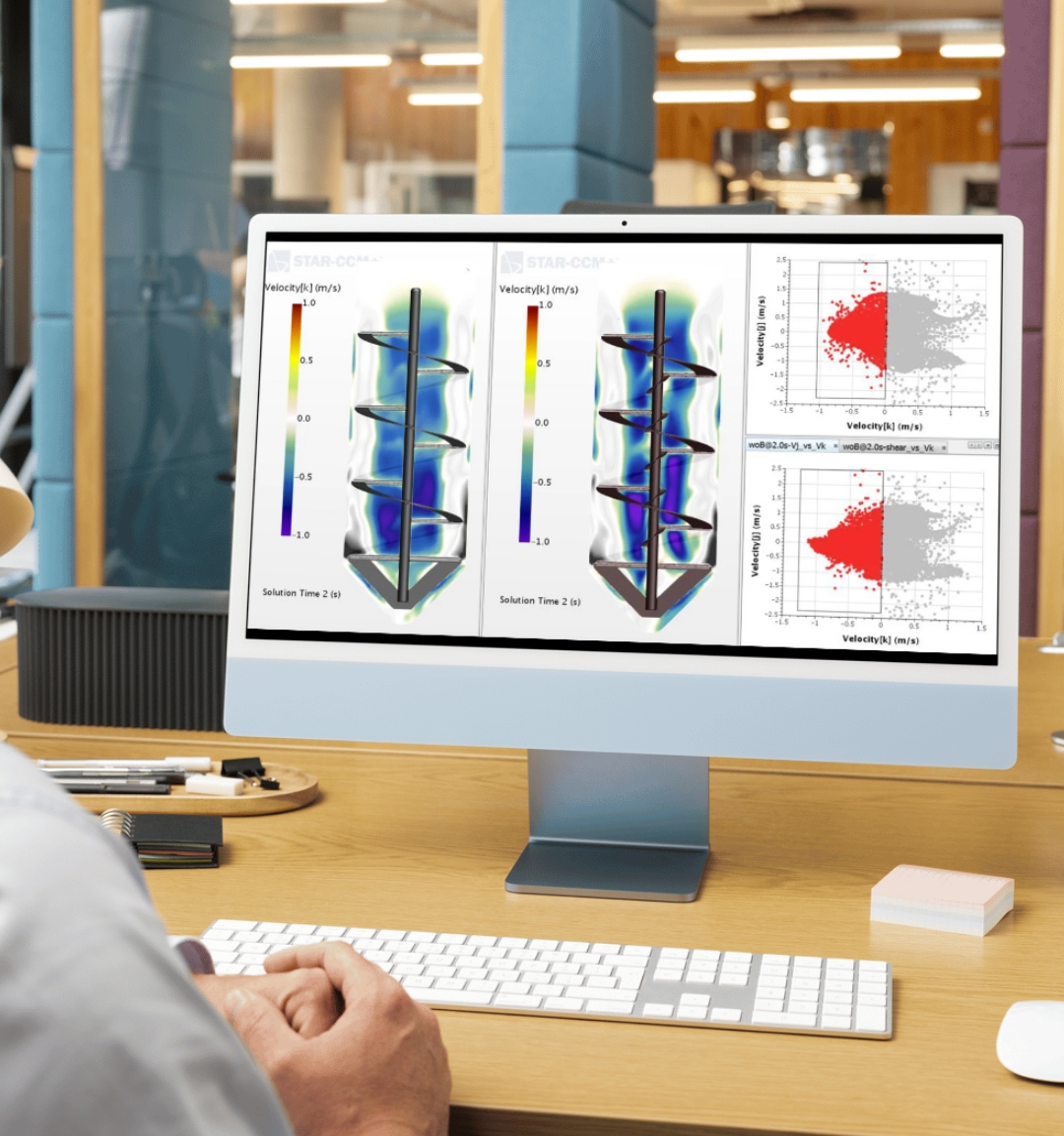
The training uses a coaxial mixing vessel equipped with a central impeller and an anchor impeller as a practical case study. Participants will explore gas–liquid multiphase flow, non-Newtonian fluid behavior, gas dispersion, and mixing performance.
Upon completion, participants will be able to develop CFD models of mixing vessels, evaluate their performance, and investigate the effects of operating conditions and vessel scale on mixing efficiency.
Sounds like something you would be interested in?
Who Should Get Simcenter STAR-CCM+ Mixing Vessel CFD Training?
This course is designed for engineering professionals involved in the design, simulation, and optimization of industrial mixing processes. It is ideal for:
- Chemical and process engineers working with mixing vessels and stirred tank reactors.
- CFD engineers analyzing rotating machinery, multiphase flow, and non-Newtonian fluids.
- Design and R&D engineers seeking to improve mixing performance and evaluate equipment scale-up.
Prerequisites:
- Basic understanding of fluid mechanics and transport phenomena.
- Familiarity with 3D CAD geometry and engineering simulation concepts.
- Previous CFD experience is recommended but not required.
Training Objectives:
- Become familiar with the Simcenter STAR-CCM+ interface and CFD modeling workflow.
- Prepare mixing vessel geometries with multiple rotating components.
- Generate computational meshes and evaluate mesh quality and independence.
- Configure impeller motion, non-Newtonian fluid properties, and transient simulations.
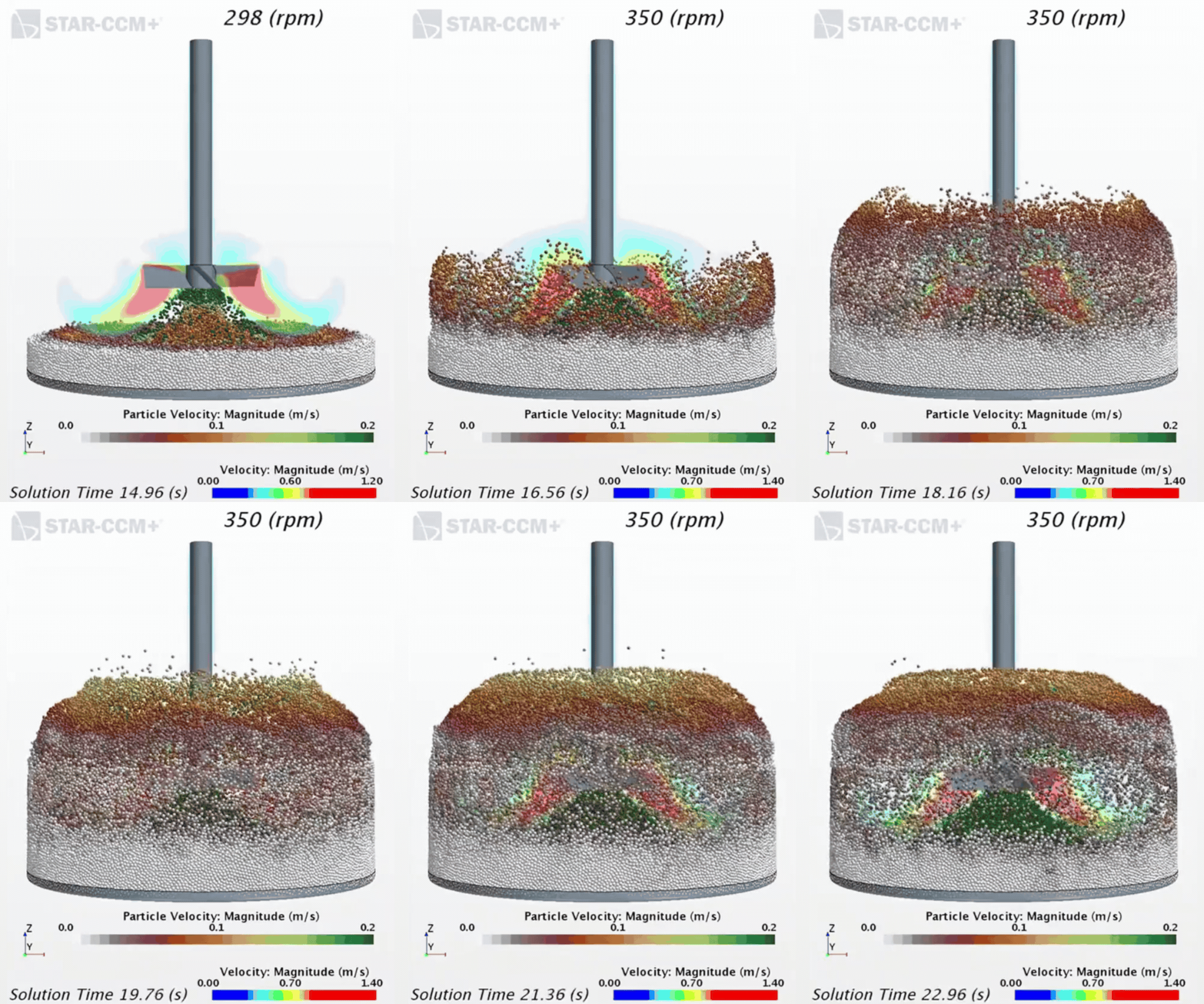
- Model gas–liquid multiphase flow and investigate gas dispersion.
- Evaluate mixing performance using flow patterns, power consumption, shear rate, and mass-transfer characteristics.
- Validate simulation results and investigate mixing vessel scale-up.
Course Topics:
Take a look at the topics covered day-to-day in our Simcenter STAR-CCM+ Mixing Vessel CFD Training. Sessions are spread across 5 days of training, allowing for ample time for skill acquisition.
Schedule Overview:
Day 1 | Day 2 | Day 3 | Day 4 | Day 5 |
|
|
|
|
|
Day 1: Introduction to STAR-CCM+ and Mixing Vessel Geometry
Build a strong foundation in the STAR-CCM+ simulation environment and learn how to prepare mixing vessel geometries for CFD analysis.
- Explore the STAR-CCM+ interface, simulation tree, and essential CFD modeling tools.
- Import and prepare a mixing vessel geometry equipped with pitched-blade and anchor impellers.
- Identify and organize the tank, impellers, shafts, sparger, and fluid regions for simulation.
Day 2: Computational Domain Preparation and Meshing
Develop practical skills in preparing computational domains and generating high-quality meshes for rotating mixing equipment.
- Create stationary and rotating computational regions and establish appropriate interfaces.
- Generate volume meshes with local refinement around impellers, vessel walls, and critical flow regions.
- Evaluate mesh quality and perform mesh refinement and independence studies.
Day 3: Physics Setup and Rotating Impeller Simulation
Configure fluid properties, impeller rotation, and transient CFD simulations to investigate mixing vessel hydrodynamics.
- Define fluid properties, including shear-thinning behavior using a non-Newtonian power-law viscosity model.
- Configure impeller rotational speeds, rotating reference frames, and transient sliding-mesh motion.
- Evaluate liquid velocity distributions, flow circulation, shear rate, and impeller power consumption.
Day 4: Gas–Liquid Multiphase Flow and Mass Transferalf Days 7 – 8: Advanced Case Studies & Analysis Techniques
Extend the mixing vessel model to investigate gas dispersion and mass-transfer behavior in aerated mixing systems.
- Configure a Eulerian–Eulerian multiphase model and appropriate gas–liquid interaction models.
- Define gas injection through a sparger and investigate gas distribution within the vessel.
- Analyze gas volume fraction, bubble behavior, turbulent energy dissipation, and estimated volumetric mass-transfer coefficients.
Day 5: Simulation Validation, Post-Processing, and Scale-Up
Apply advanced post-processing and validation techniques to assess mixing performance and investigate equipment scale-up.
- Generate contour plots, velocity vectors, streamlines, animations, and engineering reports to visualize mixing behavior.
- Evaluate simulation accuracy through convergence assessment, mesh independence, and comparisons with experimental measurements.
- Investigate mixing vessel scale-up and compare gas distribution, energy dissipation, power consumption, and mixing performance across vessel sizes.
Ready to Enroll?
Once the following form is complete, we will generate a quotation and reach out to discuss the next steps for securing seats for trainees.

