
Simcenter 3D Advanced Training

Course Overview:

The Simcenter 3D Advanced Training course is designed to provide experienced users with in-depth knowledge of advanced simulation techniques. This course focuses on solving complex engineering challenges using advanced analysis methods, including fluid flow, thermal effects, nonlinear behavior, and material plasticity. Through hands-on activities, participants will develop the expertise needed to confidently handle challenging real-world scenarios.

Let us help you develop your expertise.
Who Should Get Simcenter 3D Advanced Training?

This course is ideal for professionals seeking advanced simulation skills, including:

  • Structural and fluid dynamics engineers analyzing complex systems.
  • Thermal and mechanical engineers requiring coupled simulation techniques.
  • Simulation experts working with nonlinear models and material behaviors.

Prerequisites:

  • Completion of Simcenter 3D Essentials Training or equivalent experience.
  • Familiarity with basic FEA concepts such as meshing, connections, and boundary conditions.
  • Understanding of mechanics of materials and basic fluid dynamics principles.
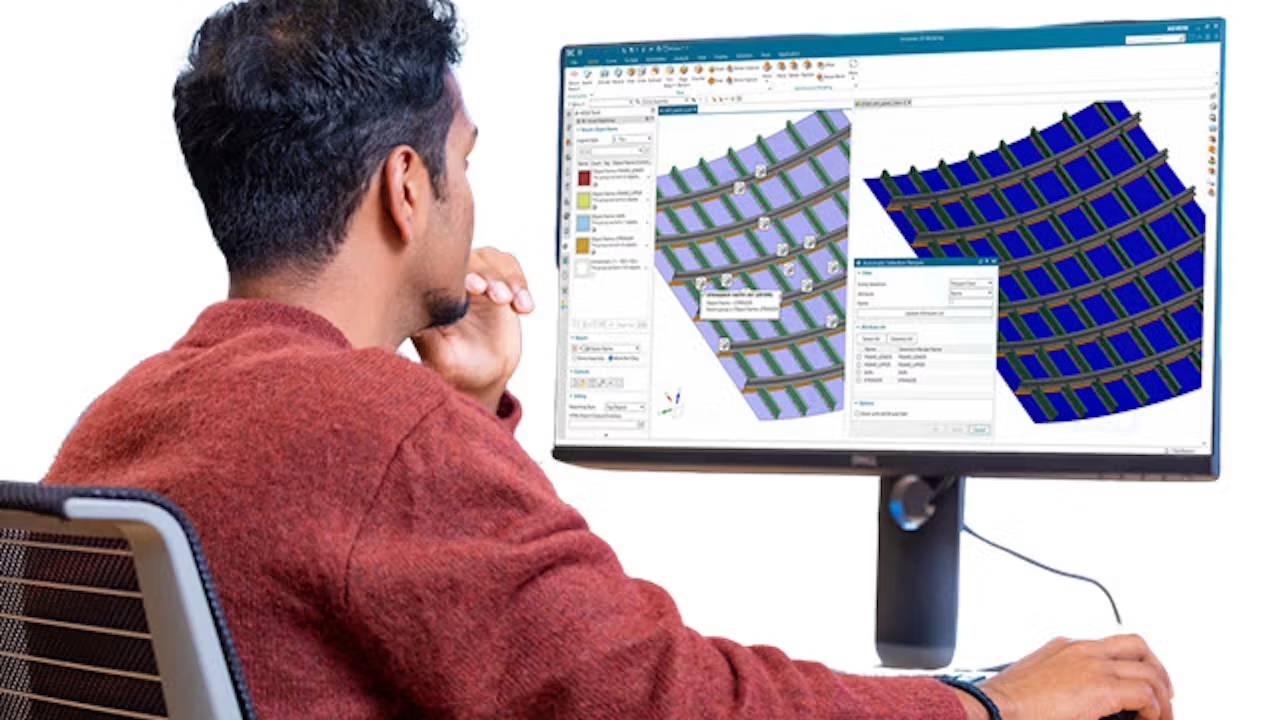
A person using Simcenter 3D software on their desktop computer.

Training Objectives:

  • Perform multi-physics analyses, including coupled thermal-flow simulations.
  • Use advanced techniques for stress life analysis and fluid dynamics modeling.
  • Conduct nonlinear analysis, including geometric and material nonlinearity.
  • Model complex contact behaviors in simulations.
  • Interpret and validate results from advanced simulations effectively.

Course Topics:

Take a look at the curriculum covered day-to-day in our Simcenter 3D Advanced Training:

Schedule Overview:

Day 1 

Day 2 

  • Advanced Multiphysics Introduction
  • Non-Linear Analysis Techniques

Day 1: Advanced Multiphysics Introduction

Introduce advanced simulation techniques for multi-physics applications like thermal, fluid flow, and stress analysis.

  • Conduct stress life analysis to evaluate fatigue in components under cyclic loading.
  • Extract fluid domains by sewing faces for CFD applications.
  • Simulate fluid flow in a pipe, focusing on pressure and velocity distributions.
  • Perform thermal transient analysis to study time-dependent heating and cooling effects.


Day 2: Non-linear Analysis Techniques

Explore nonlinear behaviors in simulations, including geometric and material effects.

  • Set up multi-step analysis to study progressive loading and boundary conditions.
  • Model geometric nonlinearity, analyzing the impact of large deformations.
  • Simulate contact mechanics, including friction, bonding, and separation in assemblies.
  • Analyze material plasticity, evaluating behavior beyond the elastic limit and predicting potential failure modes.

Ready to Enrol?

Once the following form is complete, we will generate a quotation and reach out to discuss the next steps for securing seats for trainees.