

On a hot afternoon or a freezing morning, an electric vehicle spends part of its battery energy keeping passengers comfortable and components within their operating limits. Understanding that demand matters when designing for range. Siemens Simcenter Amesim helps engineers examine thermal management alongside vehicle energy consumption, so they can assess the effect of cooling and heating choices before building a prototype.
The Challenge
An EV’s energy budget includes propulsion, conversion losses and auxiliary loads. The compressor, electric heaters, coolant pumps and fans all contribute to demand. Their consumption changes with ambient conditions, driving and the temperatures the control system needs to maintain. A design that performs well in mild weather may behave differently during a cold start or a hot-weather journey.
These demands are connected. Battery cooling and cabin air conditioning may share the same refrigerant circuit, while heat from the powertrain may be available for recovery. Evaluating each subsystem separately can hide the effect of one design choice on another. Engineers need to understand those interactions while balancing passenger comfort, component temperatures and energy use [1, 2].
The Amesim Approach
Amesim supports a system model linking the electric powertrain and battery with coolant circuits, refrigerant loops, the cabin and thermal controls. Engineers can examine pumps, heat exchangers, compressors and heaters within that wider context. The practical benefit is the ability to compare component sizing and circuit architectures against vehicle-level requirements [1].
Model detail can evolve with the task. An early study can use a simplified representation of cooling efficiency to explore its influence on range. A more detailed refrigerant-loop model can then connect performance to component sizing and transient operation. This supports a progression from architecture decisions to questions about how the system behaves during a journey [3].
The useful outputs extend beyond a temperature curve. An energy breakdown helps identify which loads deserve attention, while temperature histories show whether a proposed saving still satisfies the thermal requirements. Reviewing both together makes the engineering trade-off visible [2].
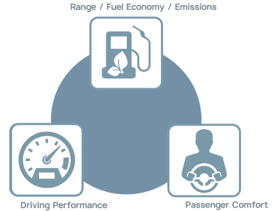
Balancing driving range, energy efficiency, vehicle performance and passenger comfort through integrated thermal management.
Use cases
After developing electric thermal architecture, Hyundai figured out the refrigerant loop accounted for nearly 29% of total electrical energy consumption during a specific driving cycle at an ambient temperature of 35°C in one of its vehicles. This was a result for that simulated configuration and scenario; it shows why cooling demand deserves attention alongside propulsion [3].
A useful next study would compare two thermal-control strategies over the same journey. Hold the ambient conditions, initial battery charge and starting temperatures constant. Record total battery energy, compressor and heater consumption, and pump and fan demand. Then compare cabin comfort and battery temperature throughout the cycle, including the final thermal state. This makes it possible to judge whether an apparent energy saving meets the same operating requirements.
There is also a practical example of model validation. Lion Electric used Amesim to develop battery thermal management and estimate vehicle range for specific use cases. The team compared the battery model with climate-controlled physical tests and adjusted its electrical performance and heat rejection. That link to measurements strengthens the basis for subsequent design comparisons [4].
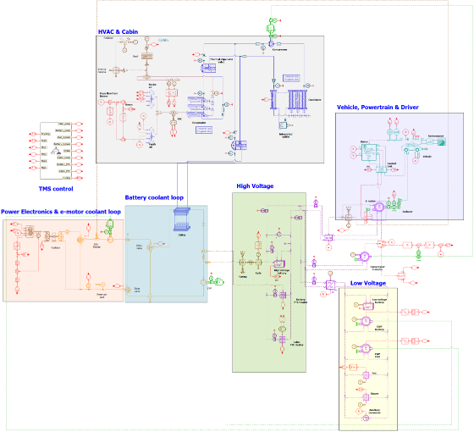
An integrated EV model in Simcenter Amesim, linking the battery, powertrain, cooling circuits, cabin HVAC and electrical loads to evaluate thermal behavior and energy consumption.
Key Takeaway
Thermal management is part of the EV energy budget from the start. Amesim brings the relevant subsystems into a connected simulation workflow, helping engineers trace demand and evaluate design alternatives. The goal is to meet comfort and component-temperature requirements with an efficient use of battery energy, supported by models checked against relevant test data.
Contact our team or email us at contact@longtermtec.com to explore how Simcenter Amesim can support your EV thermal-management and energy-efficiency studies.
Sources
[1] Siemens Thermal system simulation
[2] Siemens From heat to range Energy and thermal management done right
[3] Siemens Ultimate guide for thermal management in electric cars
[4] Siemens Lion Electric battery design and thermal management case study

