

Posted date: 11/06/2026
Reducing the weight of an aircraft landing system starts with understanding what each component must deliver. A smaller hydraulic power unit is useful only if it still meets the required performance across operating conditions. Simcenter Amesim helps engineers examine these trade-offs early by connecting hydraulic, electrical and mechanical behavior in a system simulation.
The Challenge
Landing systems bring together functions such as braking, steering, and landing gear extension and retraction. Their performance depends on the interaction of pumps, valves, actuators and control systems. Choosing components individually can leave important questions unanswered about how the assembled system will respond. Early simulation helps translate aircraft-level requirements into component specifications.
Weight reduction adds another constraint. A proposed change to a pump, accumulator or hydraulic line must be assessed alongside pressure delivery and dynamic response. Thermal behavior also matters: a compact installation may need additional cooling. Engineers therefore need a way to compare designs across the relevant loads, temperatures and operating scenarios before committing to hardware.
The Amesim Approach
Amesim provides ready-to-use physical components and a graphical modelling environment for assembling system architectures. Engineers can connect hydraulic circuits to electric motors, mechanical loads and controls, then parameterize the model using component specifications and operating data. This makes it possible to investigate system behavior while the design is still evolving. [1]
The hydraulic model predicts how pressure and flow change throughout a maneuver. Coupling it with electrical and thermal models helps engineers assess power demand and temperature alongside the required response. The practical advantage is a connected view of the design, a change in one subsystem can be evaluated for its effects elsewhere. [2]
Amesim also supports studies of degraded hydraulic-system performance under modelled failures. Engineers can compare normal operation with selected fault scenarios and identify where the design needs further investigation. Combined with design exploration, this helps focus development effort on the combinations of components and operating conditions that matter most.
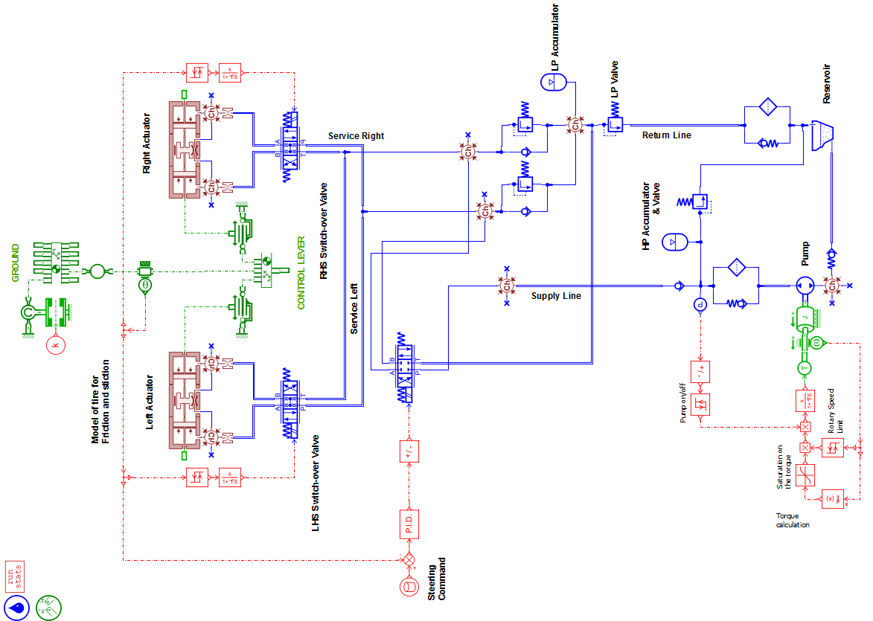
Simcenter Amesim accelerates aircraft component sizing and system-level design decisions.
Use Cases
Simcenter Amesim supported the development of a decentralized hydraulic generation architecture for emergency braking and landing gear steering on the Airbus A380. Local electrically driven micro-pumps helped reduce the need for lengthy backup hydraulic lines. Amesim provided a way to assess the proposed architecture before extensive physical prototyping [3].
The model was used to evaluate hydraulic performance, stability and thermal behavior. Results informed the sizing of the pump, tank and accumulator, as well as the assessment of heat-exchanger requirements. The case study reports that early simulation predictions were subsequently confirmed on test benches. This illustrates how Amesim can connect an architecture decision to component requirements and later physical verification [3].
A focused design study could apply the same approach to two pump-and-accumulator configurations. Keep the imposed load, supply conditions and initial temperature identical, then compare pressure recovery, actuator response and peak temperature. Reviewing these results alongside the estimated mass of each configuration would show which candidate meets the requirements and where a lighter option introduces a performance compromise.
Another study focused on designing a landing gear shock absorber featuring separate gas and hydraulic chambers. The study successfully simulated a drop test under regulatory boundary conditions, capturing the pressure and temperature evolution in both chambers and computing the characteristic stroke-load curve.
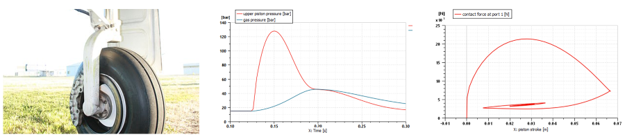
The landing gear model successfully simulated the drop test in compliance with regulatory boundary conditions.
Key Takeaway
Simcenter Amesim helps engineers evaluate landing-system weight targets together with hydraulic response, electrical demand and thermal behavior. Its value lies in making those interactions visible early, when component sizes and architectures can still be changed. With appropriate parameter data and test correlation, the model becomes a practical basis for selecting configurations and planning the next stage of development.
Contact our team or email contact@longtermtec.com to explore how Simcenter Amesim can support your aircraft system simulation.
Sources
[1] Siemens, Simcenter Amesim product overview
[2] Siemens, Fluid and aircraft hydraulic system simulation
[3] Siemens, Amesim application in A380 landing systems

