

A system model earns its value when it helps an engineer make a design decision. Simcenter Amesim supports that goal with ready-to-use physical components that can be connected into a system model. For engineering teams, the appeal is practical: spend less effort implementing familiar component equations and more time exploring how the design behaves.
The Challenge
Consider an engineer sizing a hydraulic actuator for an industrial machine. The model must represent the fluid circuit, mechanical load and control response. Building those relationships from scratch involves writing equations, connecting variables and checking that the implementation behaves as intended. Each design change can add another round of model maintenance before the engineer can assess its effect.
The engineering questions are more immediate. Will the actuator meet its motion target under load? Is the valve appropriately sized? How sensitive is the response to friction or leakage? A useful simulation workflow should make these questions easier to investigate while keeping the model assumptions clear.
The Amesim Approach
Amesim provides compatible libraries covering hydraulics, mechanics, thermal behavior, electrical systems and controls. Engineers assemble components in a graphical schematic, using the available physical models as building blocks. This reduces the need to recreate standard component behavior for each project and makes the system connections visible to reviewers [1].
For an actuator study, the workflow starts with the circuit and load, then the choice of component representations and their parameters. Dimensions, operating conditions and performance data give the model its application-specific meaning. Built-in examples and documentation provide starting points, while the required design question determines how much detail to include [2]. Teams should check their assembled model against known behaviour or measurements before using it to guide a design. The opportunity is to direct more effort toward those checks and the resulting design decisions.
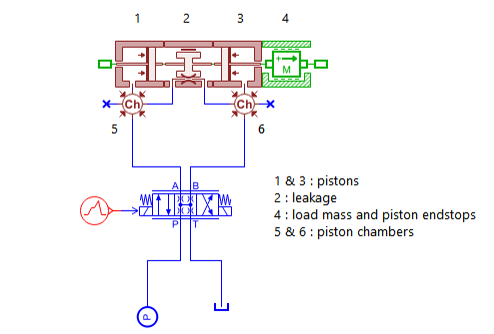
System simulation has become a must-have for your design process
Use cases
Simcenter Amesim supported engineers to develop an integrated dynamic brake, an electrohydraulic system in which an electric motor drives hydraulic pressure generation. Mando Corporation engineers investigated how circuit changes, motor performance and hydraulic properties affected braking behavior [3].
The team reported using validated components to evaluate multiple configurations with less manual work on mathematical formulas. They also described reusing the model from early concept through component design and vehicle integration. Their experience illustrates the benefit of a model that remains useful as engineering questions evolve [3].
For the actuator example, a focused demonstration could compare two valve sizes under the same load and motion command. Plot actuator position and supply pressure over time, then assess response time and pressure demand. Such a comparison turns a library feature into a design discussion: which configuration meets the requirement, and what trade-off does it introduce?
When evaluating simulation platforms, measure the effort to build and revise this same model alongside its agreement with reference data. Those checks provide a useful basis for assessing the productivity benefit in your own workflow.
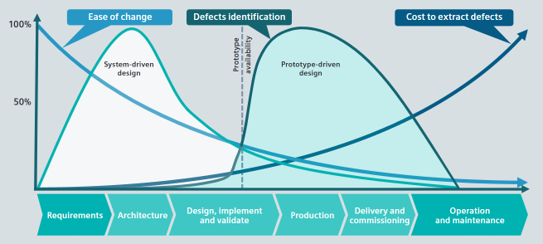
The value of early system simulation: identifying design issues when changes are easier and less costly.
Key Takeaway
Simcenter Amesim gives engineers a practical route from a physical system concept to a model they can interrogate. Its component libraries, graphical assembly and application examples support a workflow centred on system behavior. For teams that repeatedly model similar physical components, the value lies in reducing routine implementation work and making design changes easier to explore. The quality of the decisions still depends on the assumptions, data and validation behind the model.
Contact our team or email us at contact@longtermtec.com to explore how an Amesim model could support your next system design decision.
Sources
[1] Siemens Simcenter Amesim product overview
[2] Siemens Many physical domains and applications in one system simulation tool
[3] Siemens Saving lives with brake assistance systems

