
Authored by Samira Ranjbarrad – 10/21/2026
Aerodynamic performance directly affects vehicle efficiency, range, stability and customer experience. Simcenter STAR-CCM+ connects complex geometry preparation, automated meshing, high-fidelity CFD and design exploration in one workflow, helping teams move from production CAD to repeatable aerodynamic decisions faster [1, 2].
The Challenge
Production vehicle CAD is rarely CFD-ready. Full-vehicle assemblies can contain thousands of parts, small gaps, overlaps and detailed underbody or wheel features. Manually repairing and defeaturing that geometry can consume a large share of the simulation schedule, especially when designs change frequently [2, 3].
For aerodynamic development, the goal is not simply to calculate one drag coefficient. Engineers need to compare mirrors, spoilers, ride height, wheel treatments, underbody concepts and other design changes using consistent geometry, meshing, physics and reporting so that aerodynamic differences reflect the design.
The STAR-CCM+ Approach
STAR-CCM+ addresses the process from geometry to aerodynamic insight. Surface Wrapper can create a clean, watertight representation around complex or imperfect CAD while preserving important flow features, then feed that geometry into an automated meshing pipeline with repeatable surface, volume and prism-layer controls [2, 3].
For vehicle aerodynamics, engineers can combine moving-ground and rotating-wheel conditions with validated turbulence models, force and moment reports, wake visualization and automated post-processing. Simulation Operations and reusable templates help standardize recurring studies, while integrated design exploration can vary geometry and operating parameters without rebuilding the workflow for every case [1, 2].
For larger design spaces, Simcenter PhysicsAI can extend this workflow by learning from high-fidelity CFD data and rapidly predicting aerodynamic performance for new geometries. This gives teams a way to screen more concepts quickly, then return the strongest candidates to STAR-CCM+ for detailed CFD validation [5].
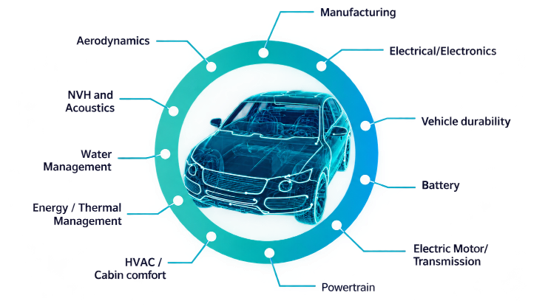
Simcenter STAR-CCM+ helps engineering teams evaluate the vehicle as a connected system rather than a collection of isolated components. Within a unified multiphysics environment, engineers can investigate aerodynamics, NVH and acoustics, water and thermal management, HVAC and cabin comfort, powertrain performance, electric motors and transmissions, battery systems, vehicle durability, electrical/electronic systems, and manufacturing considerations. This integrated approach helps teams understand interactions between disciplines earlier in development, improve system-level design decisions, and accelerate the development of safer, more efficient, and higher-performing vehicles.
Use Cases
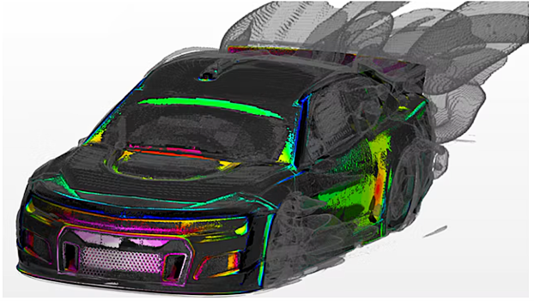
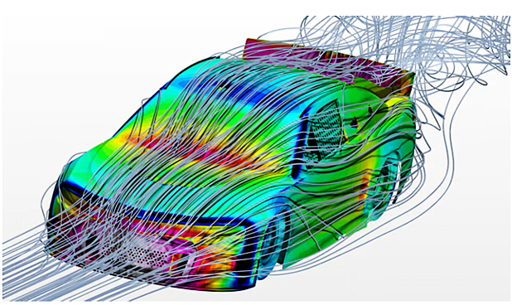
A full-vehicle study can begin directly from production CAD and establish a baseline for drag, lift, pressure distribution and wake behavior. The same automated workflow can then be reused as other features change, making aerodynamic deltas easier to compare consistently [2].
As the number of variants grows, integrated design exploration can evaluate trade-offs such as drag reduction versus aerodynamic balance across multiple parameters. PhysicsAI can further accelerate broad screening once a representative high-fidelity dataset is available, helping engineers focus detailed CFD effort on the most promising configurations [2, 5].
The productivity benefit is demonstrated in Siemens’ Hendrick Motorsports case study. Surface Wrapper reduced geometry-preparation time for large, imperfect CAD from weeks to a few hours, while automated workflows cut CFD setup effort by 85 percent. That shift allowed engineers to spend more time on aerodynamic development and less on repetitive preprocessing [4].
WEEKS > HOURS
Geometry Preparation
85% LESS SET-UP TIME
Automated CFD Workflow
Industry evidence from Hendrick Motorsports shows how automation can shift CFD effort from model preparation toward aerodynamic engineering [4].
Key Takeaway
For full-vehicle aerodynamics, STAR-CCM+ turns complex production CAD into a repeatable engineering workflow. Surface wrapping, automated meshing, vehicle-specific CFD, design exploration and AI-accelerated screening help teams evaluate more configurations, respond faster to design changes and make aerodynamic decisions earlier in development.
Contact our team or reach out to contact@longtermtec.com to explore how Simcenter STAR-CCM+ can accelerate your vehicle-aerodynamics and complex-CAD CFD workflows.
Sources
[1] Longterm Technology Services – Simcenter STAR-CCM+
[2] Siemens – Vehicle aerodynamics CFD simulation in Simcenter STAR-CCM+
[3] Siemens – Rapid CFD surface wrapping: unlock speed and consistency in meshing
[4] Siemens – Hendrick Motorsports case study: driving engineering time from weeks to hours
[5] Siemens – Geometric Deep Learning for CFD / PhysicsAI for vehicle aerodynamics

