
Authored by Samira Ranjbarrad – 10/27/2026
Simcenter STAR-CCM+ gives aerospace teams a connected path from geometry to high-fidelity CFD and design decisions. Across aircraft and propulsion programs, it supports aerodynamic performance prediction, propulsion integration, rotorcraft and other multiphysics applications [1, 2]. Gas turbine blades are a strong example of that breadth: external hot-gas flow, internal cooling and solid conduction must be understood together. A conjugate heat-transfer (CHT) workflow in STAR-CCM+ brings those effects into one model, helping engineers identify thermal risks and improve cooling concepts before costly hardware iterations [1, 3].
The Challenge
Gas turbine blades operate under severe, highly nonuniform thermal loads. Local aerodynamics, cooling-passage flow, material conduction and geometry all influence where hot spots and steep thermal gradients develop. The engineering challenge is not simply to calculate temperature; it is to understand the trade-offs. A cooling change that lowers a hot spot may also increase pressure loss, redistribute coolant or create a new limitation elsewhere. As the design evolves, teams need a workflow that can be updated and repeated without rebuilding the analysis from the beginning.
The STAR-CCM+ Approach
STAR-CCM+ connects the core blade-thermal workflow in one environment. Engineers can prepare or parameterize CAD, generate automated meshes, solve coupled fluid and solid thermal fields, and track surface heat transfer, coolant flow, pressure loss and temperature with integrated reports and visualization [1, 3].
For aerospace and turbomachinery work, specialized capabilities strengthen that workflow. Adaptive Mesh Refinement can focus resolution where the flow demands it, overset meshes support relative motion and moving-body problems, and structured turbomachinery meshing provides flow-aligned cells with automatic treatment of blade fillets [2, 4, 5]. These tools allow the same platform to support blade CHT as well as broader aerodynamic and propulsion studies.
For much larger design spaces, Simcenter PhysicsAI can learn from high-fidelity CFD data and rapidly predict full-field performance for new geometries; Siemens reports what-if exploration on the order of 1,000× faster than traditional workflows for suitable applications [7].
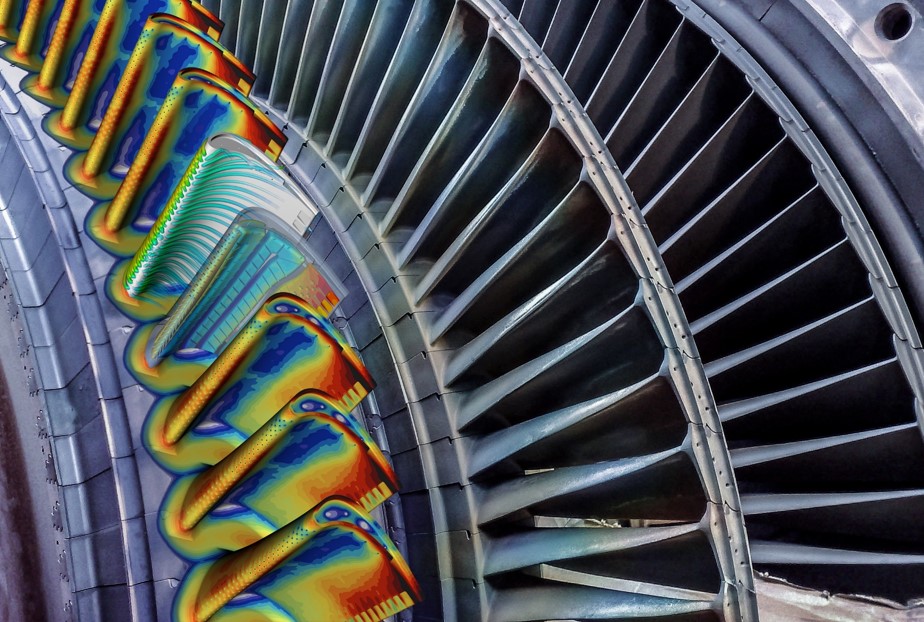
From hot-gas loading to internal cooling, STAR-CCM+ connects the physics needed to understand blade thermal behavior.
Use Case: From Baseline CHT to Better Cooling Designs
A practical study can start with a baseline blade to locate hot spots, quantify coolant distribution and establish pressure-loss and temperature metrics. The same model can then evaluate changes to cooling-hole layouts, internal passages, materials or operating conditions without changing the evaluation framework. Design Manager extends this from a few comparisons to systematic design exploration, while PhysicsAI can screen a much larger set of candidate geometries before the most promising concepts return to high-fidelity STAR-CCM+ for validation [6, 7].
The result is a staged engineering process: understand the physics, explore the trade-offs, accelerate screening with AI, and validate the strongest designs with CFD. Siemens also uses a realistic gas-turbine blade as an axial-turbine CHT training case covering geometry preparation, meshing, physics setup, solution monitoring and visualization [3].
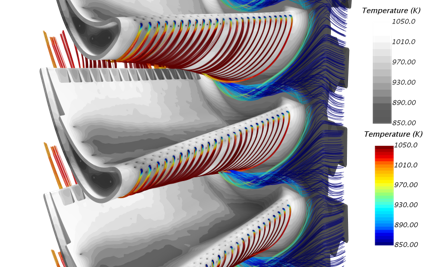
A repeatable CHT workflow turns temperature and cooling-flow results into design decisions rather than one-off CFD outputs.
Key Takeaway
Simcenter STAR-CCM+ brings high-fidelity CHT, aerospace-specific meshing, automated design exploration and AI-assisted screening into a connected workflow. For turbine-cooling teams, that means a clearer path from identifying thermal problems to comparing more concepts and validating better designs before committing to hardware.
Ready to accelerate your turbine-cooling workflow? Contact the LTS team here or email us at contact@longtermtec.com to explore how Simcenter STAR-CCM+, Design Manager and PhysicsAI can support faster, more confident gas-turbine design decisions.
Sources
[1] Longterm Technology Services – Simcenter STAR-CCM+
[2] Siemens – Aerospace Aerodynamics with Simcenter STAR-CCM+ CFD Simulation
[3] Siemens Xcelerator Academy – Axial Turbine Conjugate Heat Transfer in Simcenter STAR-CCM+
[4] Siemens – Simcenter STAR-CCM+ 2402: Turbomachinery Meshing and FSI
[5] Siemens – Simcenter STAR-CCM+ 2302: Overset Mesh and Adaptive Refinement Enhancements
[6] Siemens – Design Manager: Integrated Design Exploration in STAR-CCM+
[7] Siemens – Simcenter PhysicsAI for AI-Powered CFD Design Exploration
[8] Siemens – Simcenter X Advanced: Integrated AI Chat

